Enterprise brands that rely on demographic segmentation to find new buyers are paying the same $40 CPM to reach someone who bought twice last year and someone who has never considered the category. That gap is structural, and persona-based advertising built from behavioral, transactional, and geolocation signals is the only targeting architecture that closes it.
Why traditional audience segmentation is costing you new buyers
Standard demographic targeting can identify who might buy, but behavioral signals reveal who is about to buy: who just visited a competitor, who purchased in an adjacent category last week, who crossed the threshold from passive interest to active consideration. Missing those signals means spending brand budget on audiences with no near-term purchase intent.
People sharing identical demographic brackets carry fundamentally different purchase intent, decision-making authority, and brand relationships. A luxury travel brand targeting "high-income adults 45-65" reaches both someone who booked two cruises last year and someone who has never considered one. The algorithm prices both identically. You pay the same CPM for both.
The buyer journey problem compounds this. Traditional segmentation provides a snapshot of who someone appears to be at one moment. CMOs end up with reach metrics and awareness scores, but no line connecting those numbers to pipeline or revenue. Precision persona-informed campaigns, by contrast, increase click-through rates by up to 2x and conversions by up to 5x compared to generic demographic campaigns, according to Amazon Ads research. The gap between demographic targeting and true behavioral precision is structural, not incremental.
The anatomy of a precision persona: Beyond demographics
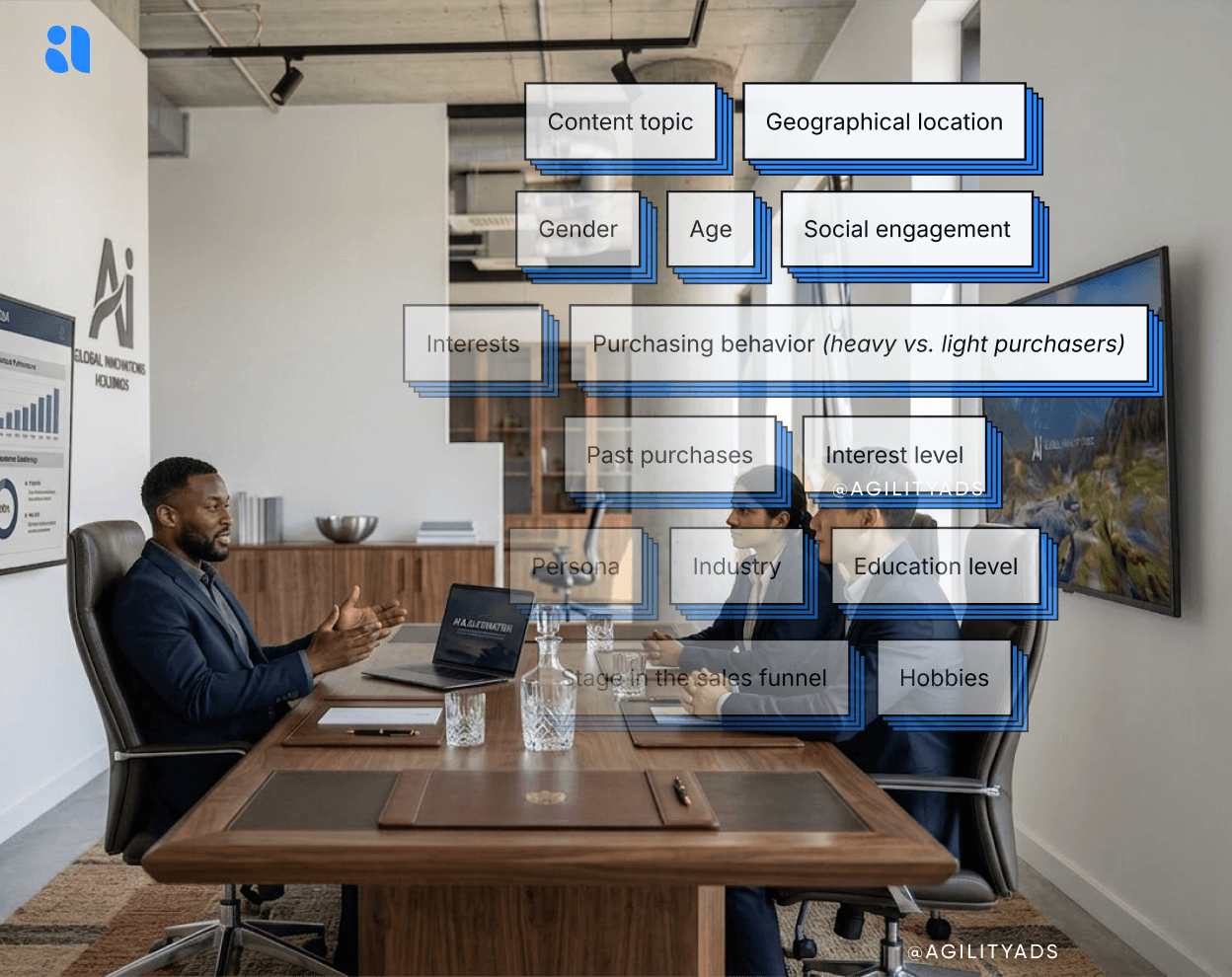
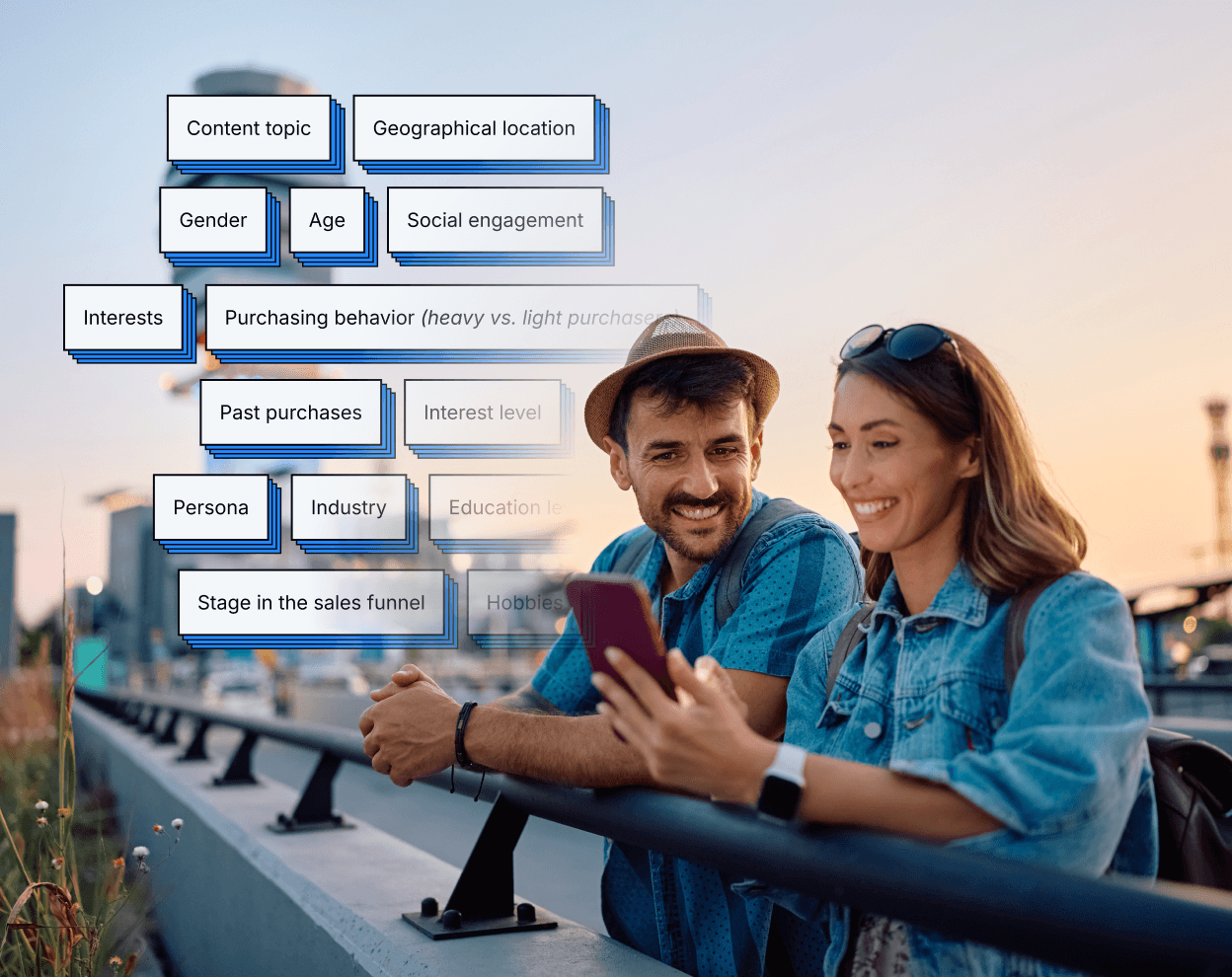
A precision persona is a multidimensional audience definition built from behavioral, transactional, geolocation, and social signals rather than demographic proxies. The goal is to identify how people actually move through the world and what that movement predicts about purchase intent.
Consider the difference between these two audience definitions:
Traditional: Women, 25-34, interested in fitness
Precision: Female, 25-34, visited 5+ running clubs in the past 90 days, purchased athletic apparel at Dick's Sporting Goods, follows fitness influencers on Instagram, searched "half marathon training," lives in a metro area with high fitness participation
The second persona is built from geolocation behavior, retail purchase history, credit card transactions, social engagement signals, and search intent data. These are observed behaviors, not inferred characteristics.
Agility's persona engineering draws on 38+ integrated data sources, including retail transaction data, transactional data, social signals, geofencing, and first-party CRM integration. This data architecture builds a behavioral fingerprint rather than a demographic profile.
The performance differential is measurable. Campaigns built on precision personas achieve 2.2x higher conversion rates at six months than traditional interest-based targeting across SEM, display, and social channels. When bareMinerals implemented sophisticated behavioral segmentation via Amazon Marketing Cloud, identifying shoppers based on cart abandonment and multiple product page views, the brand exceeded quarterly revenue goals by 50% while increasing customer repurchase rates from 12% to 28%.
How precision personas activate across channels: The open internet opportunity
Personas solve a targeting problem most enterprise marketing teams face without naming it: the inability to consistently reach the same audience across channels outside walled gardens.
Consumers now spend 61% of their online time on the open internet, outside Meta, Google, and Amazon. CTV platforms, digital audio, native content, and programmatic display command the majority of consumer attention. Yet most brands concentrate brand budgets on walled gardens because traditional demographic personas lack the data fidelity to activate precisely across open channels.
Precision personas built from retail, behavioral, and social data can be matched and activated simultaneously across Roku, Hulu, Spotify, BuzzFeed, Taboola, programmatic display, and mobile networks, as a unified audience, rather than fragmented channel buys.
Why channel consistency compounds brand impact
The strategic value runs deeper than reach. Reaching the same precise persona across multiple touchpoints builds mental availability, the mechanism Byron Sharp identifies as the primary driver of long-term brand growth in How Brands Grow. Repetition within a single channel produces diminishing returns. Consistent cross-channel presence with the same audience builds the memory structures that drive future purchase decisions.
An automotive brand that combined audience data with contextual intelligence achieved a 119% increase in reach while reducing cost per quality impression by 56%. That is a structural advantage over brands running isolated channel strategies.
Precision Creative: Tailoring messages to persona segments and buying stages
Personas are not just a targeting input. They are the foundation of creative strategy. The same brand message cannot work equally for a prospect who has never heard of your brand and one who visited your website three times last month. These are distinct psychological states that require distinct creative approaches.
Nielsen's analysis of 500 campaigns across television, digital, magazines, and radio found that creative quality accounts for 47% of campaign effectiveness, a larger share than channel selection, targeting precision, or media budget combined. Yet most marketing mix models treat creative as a constant, attributing creative-driven outcomes to media spend.
Six levers that vary by persona segment
Effective persona-based creative testing works across six independent variables: value proposition, call-to-action, emotional theme, messaging angle, people and talent featured, and art and imagery. Each lever is tested independently across persona segments, not as a monolithic creative test.
Top-performing creative variants routinely outperform average variants by 300% or more in downstream conversion impact. Broad A/B testing without persona context produces incremental optimization. Persona-segmented creative testing produces compounding performance advantages.
The 3-3-3 creative testing framework, which organizes tests across funnel level, format type, and messaging angle, structures this work at scale. Applied to precision personas, it creates a systematic learning engine that improves both brand resonance and conversion rates simultaneously, rather than trading one off against the other.
From persona to revenue: Precision matters for board-level brand ROI
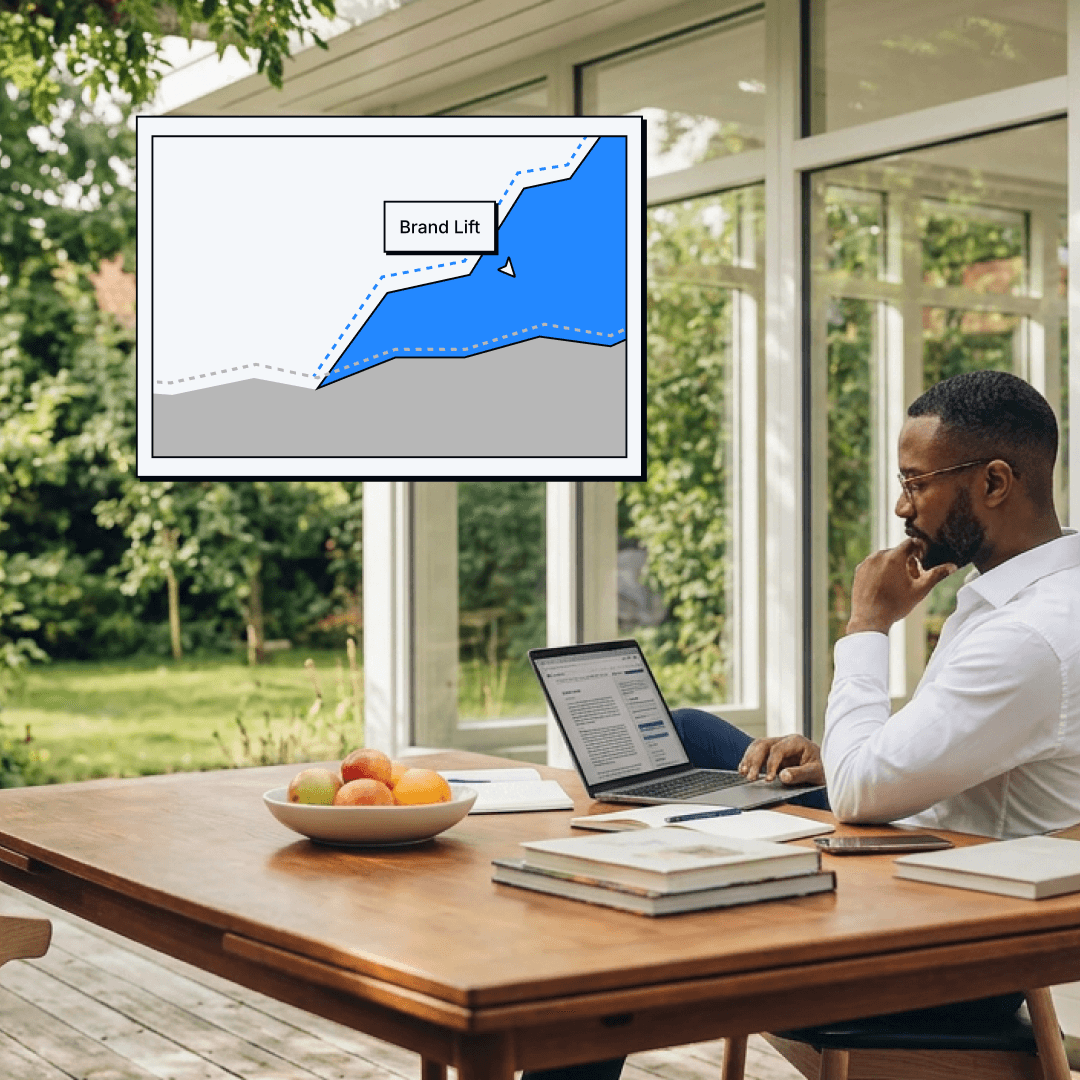
The board-level case for brand advertising has always carried one structural weakness: the lag between investment and return. Over half of advertising profits appear 13+ weeks after a campaign airs, according to Binet and Field's IPA Databank research. Boards want quarterly proof. Precision personas bridge that gap by generating leading indicators that materialize months before revenue impact.
At four months, persona-based campaigns with Agility produce a 250% increase in high-intent traffic: measurable, reportable, and correlated with downstream revenue. At 6 months, conversion rates are 2.2x those of control groups. At 12 months, new buyer acquisition is 60% higher than with performance-marketing-only strategies.
Why CRM-connected personas change the attribution conversation
When precision personas are built using identity resolution, retail data, and CRM integration, the measurement architecture tracks buyers before they ever become leads. You can prove which persona segment became a customer, which brand touchpoints influenced that journey, and what the lifetime value of that cohort actually is. These are investment-grade attribution outputs that satisfy CFO scrutiny, not awareness proxies.
Binet and Field's research establishes that brands investing in long-term brand building alongside performance marketing generate $6 in return for every $1 spent over the long term, compared to 2-3x for performance-only strategies. Precision personas make that investment defensible quarter by quarter, not just in hindsight after three years.
Performance marketing captures existing demand rather than creating new buyers. When the pool of in-market buyers shrinks or competitors increase bids, performance-only brands face CAC inflation with no long-term brand equity buffer. Precision persona-based brand advertising builds that buffer while generating measurable pipeline proof along the way.
How Agility puts precision persona advertising into practice
The execution gap is where most enterprise brands stall. Building multidimensional personas from 38+ data sources, activating them consistently across CTV, audio, native, display, and mobile, testing creative variants by persona segment and buying stage, and connecting all of it back to pipeline and revenue requires infrastructure that point solutions cannot provide.
Agility's precision brand advertising platform integrates all four components: persona engineering, cross-channel media buying, precision creative testing, and measurement science. A national fitness brand with $80M in ad spend across six brands generated $11.2M in incremental revenue and reduced CPA by 45% after implementing this approach. A multi-brand retailer operating nine brands saw 108% revenue growth with third-party distributors, alongside 26.7% year-over-year growth.
Agility's dashboards track impression-to-conversion paths, ad spend to pipeline value, cohort-based incrementality, and conversion rates to sales realization, connecting brand advertising directly to the revenue metrics CFOs and boards care about. For CMOs who need to design measurement frameworks that satisfy finance, this closes the accountability gap that leads to brand budgets being cut.
Frequently Asked Questions
Share in...