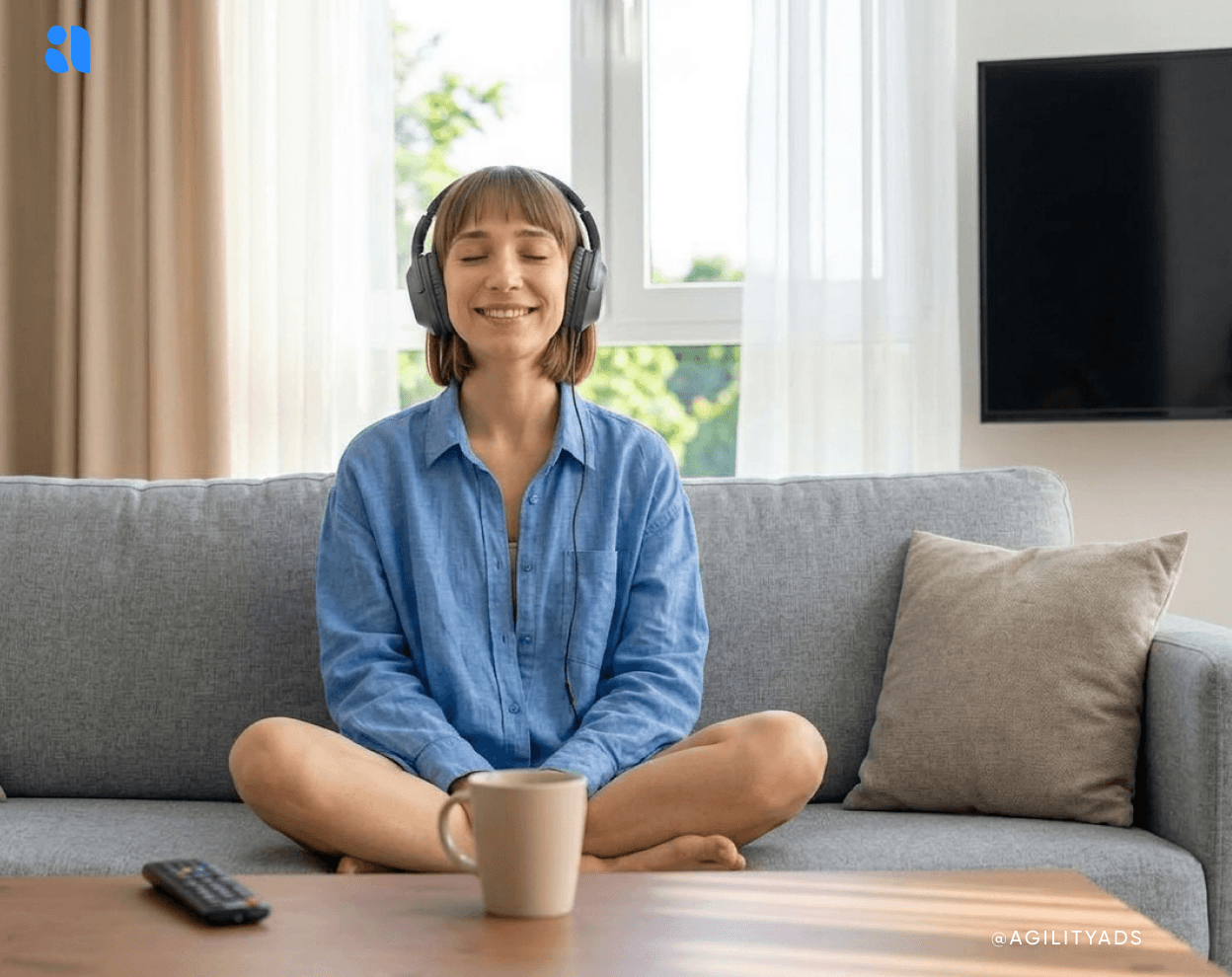
Americans spend 3 hours and 54 minutes a day with audio. Programmatic audio advertising still captures only a single-digit slice of total brand ad spend. That gap is structural, not seasonal. Social, CTV, and commerce media have captured most of the recent budget growth, while audio remains idle despite near-universal reach.
The channel is not small. Programmatic audio is a $2.3B market, growing 18% annually, and platforms have already addressed the old objections around targeting, measurement, and fragmented inventory. CMOs with eight-figure budgets are overpaying for reach they could buy cheaper on logged-in streaming, satellite, and major podcast inventory. This article maps the five shifts that turn audio into a measured line item in the plan.
The 3.5-hour blind spot: Why brand budgets miss where audiences actually spend their time
Start with the right number. Americans 13 and older spend 3 hours and 54 minutes a day with audio. That covers streaming music, podcasts, AM/FM radio, satellite, and live sports streams. Audio sits at roughly 20% of total daily media consumption. Brand budgets are nowhere close.
Most CMOs allocate a small fraction of digital spend to audio, and many allocate nothing at all. The gap is the second-largest attention pool behind video, by hours. Brands buy it at a discount because the planning system still treats audio as a side bet.
The forecast cycle makes the gap impossible to miss. Social media is projected to grow 14.6% in 2026, while audio is forecast to be flat or shrink over the same cycle. Demand is not the problem. Audio reach is near total: radio alone reaches 93% of U.S. adults monthly, and streaming and podcasts push the combined number higher. Supply is mature, the audience is huge, and the price is soft.
Programmatic audio advertising has matured into a measured, identity-resolved, open-internet channel that earns its seat at the CFO's table. The frame is simple. Where does attention actually sit, why is it mispriced, and how do you buy it on the same scorecard as every other line item?
Audio cleared the privacy bar before the rest of the web noticed there was one. Streaming, satellite, and podcast ad insertion run on logged-in identity and contextual signals, not third-party cookies.
What audio advertising actually is in 2026 (and why most planners still think it's ten years ago)
Programmatic audio advertising is the auction-based, automated buying of streaming music, podcast, and digital radio ads through the same demand-side platforms used for display and CTV. The buying motion is identical. The inventory now spans every major audio platform, including leading streaming music services, satellite radio, and the major podcast networks with server-side ad insertion.
The dollars are not small. Programmatic audio reached $2.3B in 2025, growing 18% year over year. Programmatic now claims 30% of the digital audio market. The strongest single signal of demand: one major streaming ad exchange saw a 222% increase in the number of monthly active programmatic advertisers since its launch in April 2024.
Format options match the rest of digital. Buyers can pick standard 15- and 30-second spots, host-read or announcer podcast reads, active creative tied to context, and companion display inside the player. Sequential setups that hand off from audio to CTV or display now run within a single identity graph.
The myth that audio is a radio buy belongs in the past. Today, the channel runs the same targeting, frequency caps, brand safety controls, and outcome measurement as the rest of the open internet. Legacy DSPs still treat audio as a separate silo with its own seat, plan, and reporting line. That structural choice is the source of the share-of-ear arbitrage. Brands that buy programmatic audio advertising inside the same plan as CTV and display capture the price gap the silo creates.
Why the targeting problem is solved: Precision personas work in audio
Audio used to just mean genre and daypart, but those days are over. Streaming login data, device graphs, and first-party CRM data now carry into audio with the same precision used in CTV and display. A persona built once across dozens of data sources can hit a CFO-in-footwear on CTV at breakfast, audio on the commute, and display at the desk.
That is the model Agility builds around: one persona, one creative testing system, applied across the open internet. No other platform treats audio, CTV, display, and native as a single unified channel.
Contextual targeting in audio also outperforms the broad demo buy. Podcast topic targeting, live sports, news streams, and mood signals like drive-time or workout move the needle harder than age and gender. Intent changes everything. People listen with active intent during commutes and workouts, not as background noise behind work.
Privacy is audio's quiet advantage. Audio was cookieless long before cookieless became an industry headline. Streaming music, satellite radio, and podcast dynamic ad insertion all run on logged-in identity and contextual signals today. It endures under GDPR, CCPA, and ATT. As the rest of the web loses signal, audio's targeting story only gets stronger.
This kills the spray-and-pray story programmatic audio advertising earned early on. The bad-attribution buys that gave audio its reputation were untargeted reach plays with no measurement and no creative discipline. The 2026 version runs on the same persona graph, the same identity stack, and the same outcome signals as a precision creative testing plan in CTV.
The measurement playbook: Brand lift, incrementality, and attribution for programmatic audio advertising
The "audio is unmeasurable" line is a decade out of date. Brand lift studies, pixel-based attribution, and holdout-group incrementality tests are now standard for programmatic audio advertising. The infrastructure was shipped years ago, but most plans have not picked it up.
Brand lift in audio is measured using logged-in test and control groups across streaming and satellite platforms. The lift sizes are real, and audio often over-indexes on unaided awareness because the message lands without competing visual attention. A brand lift study built to satisfy a CFO works the same way in audio as it does in CTV.
Incrementality tests run in two ways. Geo holdout designs work for radio and addressable streaming. User-level holdouts work inside platform identity graphs across major streaming music and satellite services. Audio's unique reach, the listeners not duplicated by CTV or display, often shows the highest incremental contribution in a marketing mix model.
Attention research backs the measurement story. Eye-tracking and EEG studies from Dentsu consistently show that audio meaningfully outperforms display in capturing active attention. The reason is mechanical. People do not skip audio the way they skip a banner.
Cross-channel work is where audio earns its keep. Per the System1 long-running brand study on advertising effectiveness, TV alone yields a 33% lift in large-business effects. Online video alone produces 25% lift. Run them together, and combining TV and online video reaches 54% lift. Audio bolted on top pushes the curve further by reaching listeners that screens never see.
How to build a programmatic audio advertising strategy that earns its budget line
Five steps, in order.
1. Base the plan on share of attention.
Audio is roughly 20% of daily media. A test allocation of 8% to 12% of digital spend is a defensible starting point. Anything under 5% is not a test, but rather filler.
2. Buy audio as one channel, not three.
Streaming music, podcasts, and digital radio should run inside one persona, one frequency cap, and one creative system. Treating them as three separate plans is what makes audio look small and unmeasurable.
3. Standardize creative.
The kit is two or three core 30-second reads, active variants by persona and context, and sequential setups that hand off to CTV or display. The principles that drive active creative optimization in display apply 1:1 to audio.
4. Instrument the test from day one.
A holdout, brand lift study, and pixel or MMM feed should be in place before the first impression serves. Programmatic audio advertising should not run a quarter without a measurement artifact attached. The shop that runs audio dark for 90 days, then asks "did it work?" is the shop that decides audio does not work.
5. Review on the same scorecard.
The four numbers that matter are incremental reach, cost per incremental attention-second, brand lift per dollar, and contribution. Kill what does not earn and scale what does.
The strategic point sits underneath all five steps. The brands that treat programmatic audio advertising as a first-class open-internet channel are buying the largest underpriced pool of reach in brand media today. Same persona, same measurement, same budget logic as CTV and display. Everyone else is funding the discount.
How Agility runs audio advertising as an open-internet line item
Audio belongs on the same plan as CTV and display, with persona targeting and a cohesive creative system. That is how Agility runs it.
Persona targeting is the starting point. Agility builds personas from dozens of geo-, demographic-, and behavioral-data sources, then applies them across audio, CTV, display, and native.
Creative excellence means 30-second reads built as active variants, refreshed by persona and context. Media buying runs within the same DSP and frequency graph as the rest of the plan, keeping audio within a single budget cap.
Measurement science closes the loop. Brand lift, holdouts, and incrementality studies report on the four numbers that matter: incremental reach, cost per attention-second, brand lift per dollar, and contribution.
See what precision brand advertising looks like for your brand at agilityads.com/test-precision-advertising.
Share in...