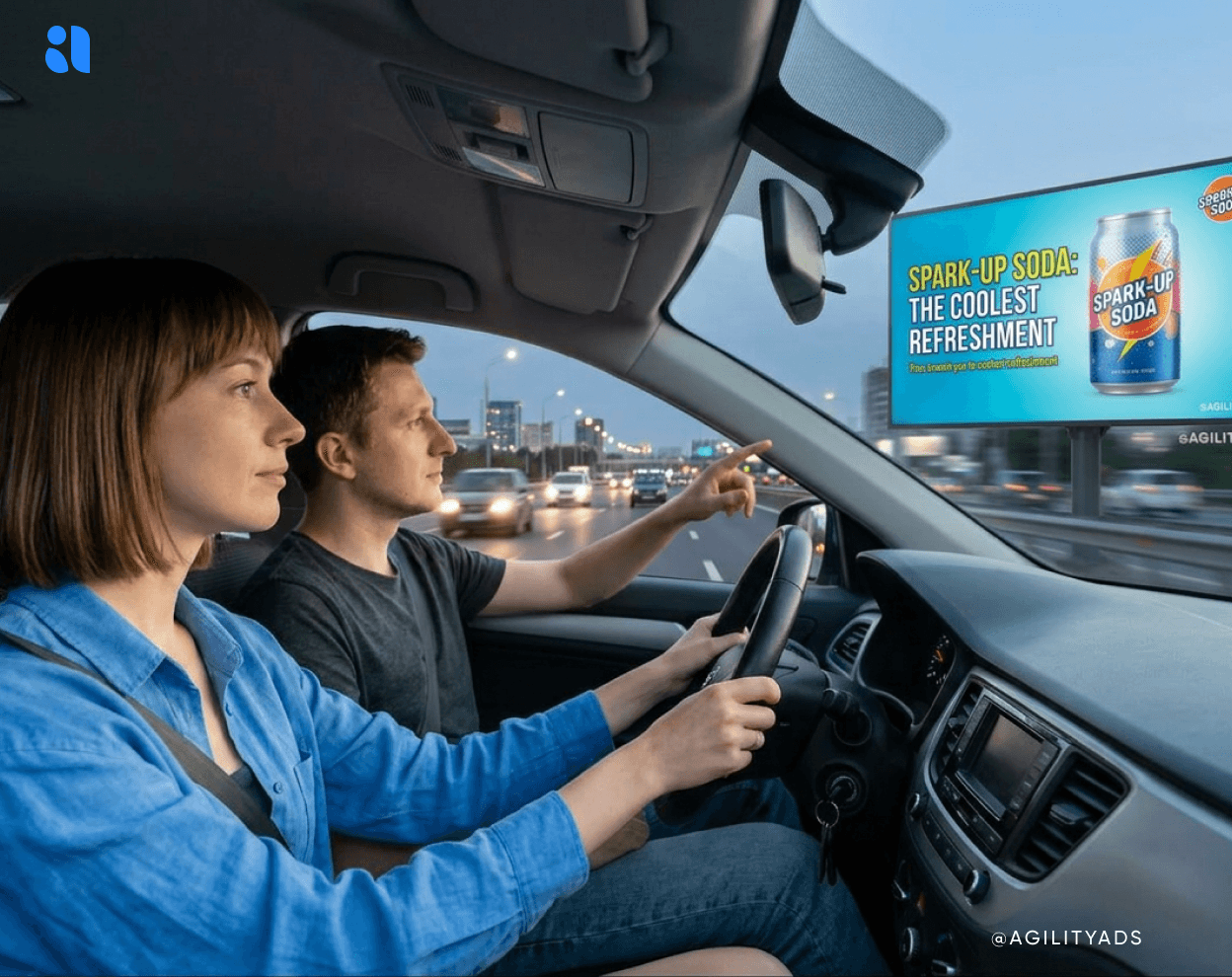
A digital screen above a highway can now bid for your impression in the time it takes a car to pass it. That's programmatic DOOH advertising: out-of-home inventory bought in real time, by audience, the same way you buy display or connected TV. The auction logic that places a banner ad now fills a fifteen-second spot on a mall screen. The poster you once rented by the month? It's a node now. You target it, measure it, and tie it to revenue.
A programmatic screen sits in the same open-internet plan as your CTV and display, not on a separate billboard line.
Out-of-Home stopped being a billboard buy
A digital screen now drives a measured visit, not just a glance. 57% of consumers who notice a directional digital billboard visit the business right away, per Nielsen's Digital OOH Advertising Study. One tactic, a directional board, points to a nearby store, and the action is a search, a tap for directions, or a walk through the door.
That single fact rewrites the category. Out-of-home used to be a reach-and-frequency buy on a static board. You rented a location, hoped the right people drove past, and waited weeks for a vendor report.
The programmatic version changes the unit of work. Programmatic DOOH advertising is out-of-home inventory bought, targeted, and attributed through the same demand-side infrastructure as CTV, audio, and display. It's open-internet media that happens to live on a screen in physical space. The screen bids for your audience in real time, just like a connected TV slot.
The old mental model was a poster you bought monthly. The new one is addressable, persona-aligned, measurable, place-based media. You buy an audience and a moment. Not a slab of vinyl.
The buy now ties to revenue. Agility's work with one franchise business showed the range: cost per franchise visit dropped 65%, with a 38% lift in foot traffic. Those are store visits attributed to exposure, the kind of number a CFO will read. The screen became a performance node, and the way you measure brand advertising now applies directly to it.
What actually changed: From posters to programmatic
Two shifts made the difference. Screens went digital, and open exchanges opened them to real-time bids. That combination turned out-of-home into biddable inventory, just as it turned display and connected TV programmatic. A buyer now sets the audience, budget, and conditions in software, and the screen responds in real time.
The first shift was supply. Almost every roadside board is now a digital panel that can swap creative in a matter of seconds. The second shift was the pipes. Exchanges and demand-side platforms route bids to those panels, so a screen can sell each play to the highest bidder.
Then, data made the audience concrete. Location and device-graph signals turned 'a screen in a city' into 'a screen seen by these personas at these moments.' Geofencing now resolves to one-meter zones. A 12-month look-back tells you who passed a given screen over a year, not just today. You buy a moment against a known crowd.
Is the fraud problem the same as open-web display?
No. The quality question changes once the ad lives on a physical panel. About 25% of open-web programmatic spend is lost to waste, per the ANA's Programmatic Media Supply Chain Transparency Study. A physical screen has no bot traffic to inflate it, and a 36-hour audience scrub removes stale or low-quality device IDs before a campaign reads them.
DOOH is a node in the open-internet persona graph
Plan a DOOH screen as one part of your open-internet mix, not a separate billboard line. Consumers spend 61% of their online time on the open internet, not inside a few walled gardens, and DOOH is the physical-world surface of that same market. A highway screen and a streaming ad can reach the same person. The plan should treat them that way.
That person is the unit that matters. A persona graph is a privacy-safe map that links one anonymized household to every screen it uses, across CTV, streaming audio, mobile, and DOOH. You target the persona once, then cap frequency across all four surfaces.
Sequencing makes the channel pay. A screen near the office primes a household in the morning. That household converts on CTV that night, or on paid search the next day. Single-channel reporting never sees the handoff.
So the DOOH impression seems to have had no effect, but it did the priming. The conversion just landed in another channel's column. Most attribution tools miss the connection.
One audience, one frequency budget, four surfaces in order. Pair DOOH with CTV, and the graph compounds: CTV alone can lift conversion rates in other channels by up to 5x, and the primed household is the one that the screen has already reached.
Measuring a screen on a highway like a performance channel
To measure programmatic DOOH advertising like a performance channel, tie spend to outcomes: foot-traffic lift, cost per visit, and incremental revenue. Skip impression counts. The method is geo-based lift and visitation attribution, in which an exposed audience is compared with a matched control. That's the proof that a CFO will sign.
Skeptics ask three questions, and a programmatic screen answers all three with hard numbers:
A CFO asks | What the screen measures |
Did anyone act? | Visitation lift vs. a matched control |
What did it cost? | Cost per incremental visit |
Did it pay? | Influenced revenue and ROAS |
Agility's franchise work shows the shape of that proof. One place-based, foot-traffic program drove 1,110% ROAS and $21M in influenced revenue, all of it tied to real exposure, not awareness scores.
How do you make DOOH defensible to a CFO?
Geo-based lift compares exposed markets against matched control markets, so you isolate what the screen caused. Visitation attribution then links anonymized devices seen near a screen to later store visits. Across Agility's incrementality portfolio, 89% of campaigns showed statistically significant lift, the kind of rigor a finance team accepts.
The visits hold up, too. Nearly two-thirds of DOOH viewers take at least one measured action after seeing a digital billboard, the same causal logic behind incrementality testing, applied to a screen on a highway.
How CMOs deploy programmatic DOOH without building a silo
Deploy programmatic DOOH advertising inside your existing open-internet plan. Buy it against the same personas, under one frequency cap, toward the same outcome you set for CTV and display. Then judge it on foot traffic, search, or revenue.
The first move is shared infrastructure. Plan the screen in the same buying tool, against the same persona graph, as every other channel. One frequency cap spans all of them. That stops you from paying to hit the same household twice.
Buy it as a channel, not an experiment. Consumers already spend most of their online time on the open internet, and a DOOH screen extends that same audience into physical space. The peers who plan it this way fold it into the media plan they already run.
Set the success metric before you launch
The metric drives the buy. A foot-traffic goal points you to screens near your stores. A revenue goal points you at geo-lift against a control. Decide before the budget moves.
Treat the channel as a precision brand surface that compounds. It adds physical-world reach to the open-internet graph and primes the conversions of other channels. The lift holds. A screen that primes today keeps paying out for months.
The screen is a node that feeds the same revenue as your CTV and display efforts already drive. Build it in once, and it pays every week after.
How Agility runs programmatic DOOH as a persona channel
A screen on a highway is only as good as the audience it reaches. Agility plans programmatic DOOH the way it plans CTV and display. Persona targeting picks the household first, and the persona itself is an AI-assisted audience. Geofencing resolves it to one-meter zones, and a 12-month look-back finds who passed the screen over the year. The buy runs through media built for biddable inventory, not a vendor's monthly poster rate.
Then measurement science proves it. We score the screen on geo-based lift against a matched control, the same method that makes a DOOH buy defensible to a CFO. That turns an impression count into visits, cost per visit, and revenue.
Creative carries the moment. We measure six levers per ad: value proposition, CTA, emotional theme, messaging, talent, and imagery. The spot that lights up a mall screen has to earn its place.
See what precision brand advertising looks like for your brand at agilityads.com/test-precision-advertising.
Share in...