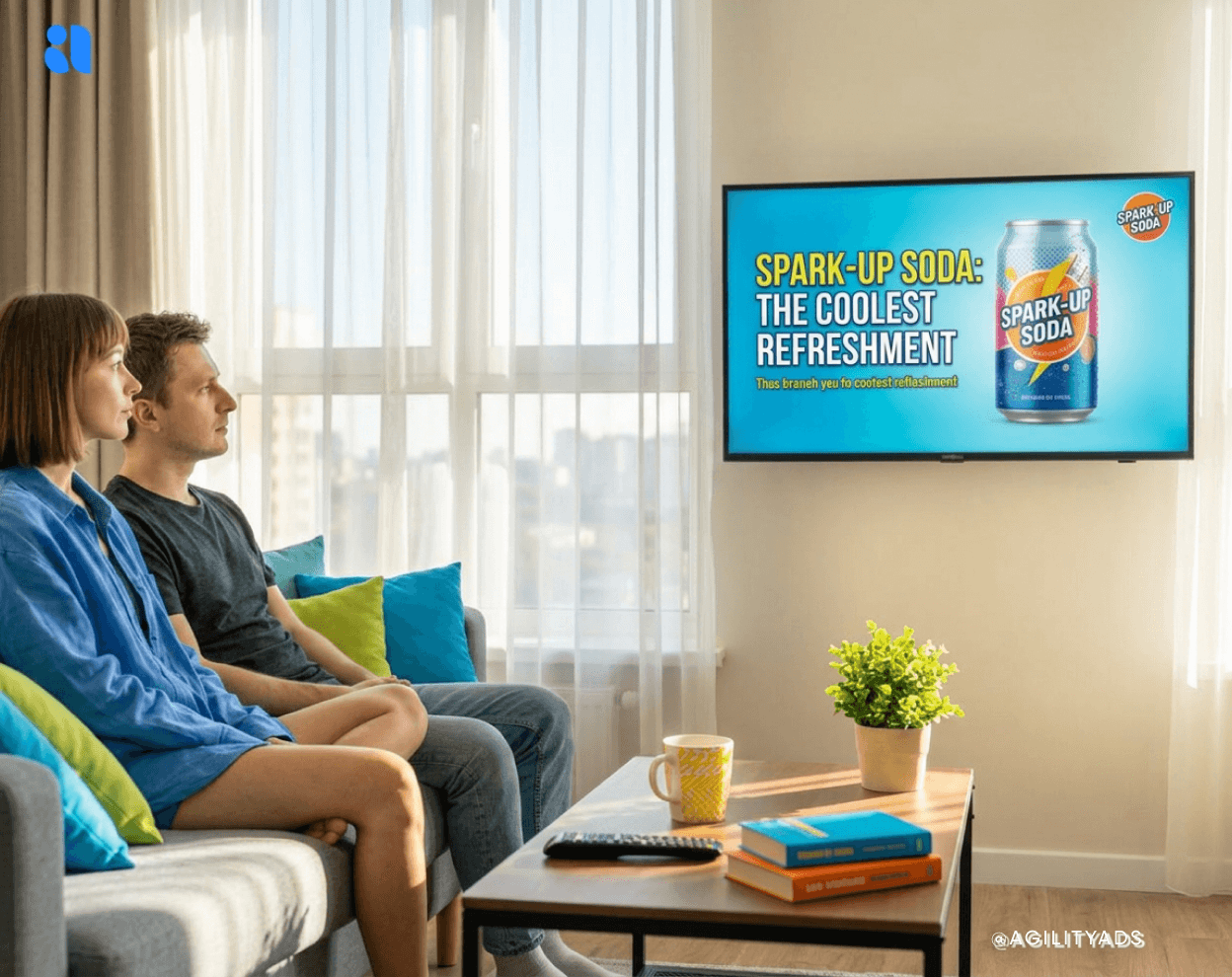
Targeting is not the biggest lever in CTV performance. Creative is. Nielsen and NCSolutions spent a decade linking ads to sales and found that creative quality drives more lift than targeting, reach, or recency. Most CTV ad creative best practices ignore that finding. Brands pay $30 CPMs for premium streaming inventory, then run spots cut for phone feeds. Viewers notice.
Creative is the largest unmanaged variable in CTV performance. Here are five practices to manage it: decompose spots into measurable levers, build persona variants, match emotion to buying motive, score on business outcomes, refresh when results decay.
Most brands are paying premium CPMs to show CTV viewers ads made for somewhere else
Most CTV budgets pay premium prices for creative built somewhere else. 40% of the ads consumers see are irrelevant to them, per Bain and Deloitte research. On the biggest screen in the house, that mismatch is expensive. In fact, few line items waste more.
But the money keeps arriving anyway, no matter how poorly the creative fits the screen. CTV display ad spending will reach $33.35 billion in 2025, with nearly all of it going to video. Brands pay streaming CPMs that dwarf their social rates, a premium justified by where the ad will play. But then they run the same files.
What fills those slots rarely matches the screen. Most brands repurpose: a linear spot trimmed for streaming, or a vertical social cut-down stretched to 16:9 with captions sized for a phone. That asset was built for a thumb mid-scroll. Now it plays to a household on a couch, ten feet away.
Of course, the premium is rational. CTV buys a premium context: full screens, long attention, shared viewing. A brand fully controls exactly one part of that impression: the creative file. Media teams negotiate every basis point of the CPM. But almost nobody audits whether what gets delivered actually fits the screen the budget bought.
That blind spot costs more than any targeting mistake. Measurement already gets rigor: most teams can prove what connected TV drives down to the dollar. Creative gets a brief and a prayer. The five CTV ad creative best practices that follow treat creative as a system: measurable levers, persona variants, emotion matched to motive, outcome scoring, and evidence-triggered refresh. Each one turns a judgment call into a managed input.
Why repurposed spots fail on the living room screen
Repurposed spots fail because they solve the wrong attention problem. A social cut exists to stop a thumb mid-scroll, in under two seconds, with captions doing the work. A CTV spot has to hold a room. Same file, opposite job.
The mismatch shows up in how attention works on each screen. A feed ad fights for a glance. A CTV spot gets the full 15 or 30, sound on, in a room that is already watching. A spot engineered for its first two seconds wastes everything after them, and that wasted stretch is the part the premium CPM bought.
Linear spots fail differently. A network spot assumes mass reach: one message for everyone watching the game. CTV inventory is bought audience-first. Paying to reach a specific household, then serving the broadcast message, buys precision delivery for a mass-market ad.
Co-Viewing Changes Who the Ad Talks To
Almost 80% of all Connected TV viewing is done together. The unit of persuasion becomes the household: mixed ages, mixed motives, several roles in one purchase. A 25-to-54 demo spec says nothing useful about that couch.
Creative built for an actual persona fits this delivery model. Persona-based targeting has already replaced simple demographics on the buying side. The creative side rarely follows.
Social feed asset | Living room screen | |
Hook window | First 2 seconds | The full 15 or 30 |
Sound | Off by default, captions carry meaning | On, shared across the room |
Viewer | One person, one thumb | A household often watching together |
Message target | Broad interest or demo | The persona behind the purchase |
The mismatch leaves a clear signature in reporting. Frequency climbs. Lift stays flat. The spot completes, because CTV spots almost always complete, and still moves nothing. Most best-practice lists skip this check because completion appears to be success.
Best practices 1-3: Engineer the creative, don't just produce it
The first three practices happen before launch. Deconstruct every spot into named levers. Build persona-specific variants instead of commissioning a single hero film. Match the emotional register to the buyer's motive, not the brand team's taste. Together, they turn creative from a finished asset into a set of inputs you can measure and improve.
Practice 1: Decompose the ad into measurable levers
Creative decomposition is the practice of naming the job of every element in an ad before production starts. Six levers cover most spots: value proposition, CTA, emotional theme, messaging, people and talent, and art and imagery. If nobody can say what the opening scene is doing, nobody can improve it.
The payoff shows up in media costs, not just taste. Higher creative quality is statistically linked with increased media efficiency and lower CPMs. Named levers also give you something to test, which is the whole premise of creative variant testing.
Practice 2: Build modular, not monolithic
Shoot once. Assemble many. A modular shoot captures interchangeable openings, proof points, and CTAs, then cuts a distinct variant for each persona. The hero-spot model spends the entire production budget on a single guess.
Viewers reward the rotation. 84% of consumers say ads that rotate or update rather than repeat are more likely to capture and hold their attention. One household sees the price-led open while another sees the craftsmanship version. Same footage, different argument.
Practice 3: Match emotion to the buying motive
The emotional register belongs to the persona, not the creative director. The same SUV earns a status story for one household and a durability story for another. Both stories are true. Only one moves the people on that couch.
This approach holds up under hard measurement. In Agility's own client data, a luxury fashion brand engineered its creative around these levers. The campaign measured a 136.6% realized sales lift and returned $1.95 in incremental revenue for every dollar it spent. Those numbers came from incrementality tests, not platform dashboards.
Best practices 4-5: Close the loop between creative and outcomes
The final two practices govern what happens after launch: score every variant on business outcomes, then refresh only when the evidence says a lever has decayed. Completion rate qualifies for neither job. Run together, the two practices turn every flight you launch into training data for the one that follows.
Practice 4: Score on outcomes, not completion rate
Completion rate flatters everyone. CTV delivers 90-95% video completion rates, compared to 40-60% for digital video, because most premium inventory is non-skippable. That means a weak ad completes about as reliably as a great one.
Instead, hold creative to the media standard. Did sales move? Score each variant on outcomes per persona, like branded search, site visits, and realized sales lift. Attention metrics are a diagnostic, not a KPI. Assign one outcome metric per lever before launch, using a CFO-ready creative testing framework.
Practice 5: Refresh on evidence, not on the calendar
Calendar rotation wastes money in both directions. An ABX study of 25,000 radio ads found only two showed any decline in creative effectiveness. Marketers tire of ads long before their audiences ever do, which means a quarterly refresh often retires creative that still earns.
The opposite failure is quieter. A variant decays for one persona while the flight average still looks healthy. Watch lever-level signals instead. For example, when the price-led CTA stops moving branded search for one persona, swap that module, keep the rest, and log the change.
That log is the compounding asset. The luxury fashion lift in Practice 3 came from this loop. Each flight taught the next which value proposition and imagery earned the return. Brands that close the loop get smarter with every dollar. Brands that refresh by calendar restart from zero each quarter.
The CTV creative operating checklist
The five CTV ad creative best practices can be compressed into one pre-flight review. Ten minutes of review protects the media budget behind it. Run the list before launch:
Levers named: Someone on the team can state the job of every element in the spot.
Variants mapped: Each target persona has its own cut, not a shared hero film.
Emotion justified: The register matches the buying motive in the room, and the brief says why.
Outcome KPI set: Every variant gets a business metric before launch, such as sales lift or a brand lift study that your CFO accepts.
Refresh trigger defined: A lever-level signal decides when a module swaps, never a calendar date.
What to ask your platform or agency
Three questions separate creative partners from traffickers. Can they measure performance at the lever level? Can they assemble persona variants? Can they tie each variant to incremental outcomes? A partner who only runs the spot you hand them leaves the biggest lever unmanaged: advertising creative accounts for 21% of incremental sales, per Nielsen and NCSolutions.
The stakes
The inventory debate is over. A combined 91% of advertisers think CTV is as effective or more effective than linear TV at driving return on ad spend. Supply quality stopped being the constraint years ago.
Creative discipline is the new one. The brands winning the channel treat each spot as a precision instrument: decomposed into levers, versioned by persona, scored on outcomes, refreshed on evidence. Everyone else is paying premium CPMs to air a guess.
How Agility scores all six creative levers on CTV
The checklist above assumes a partner who can measure creative below the spot level. Agility built its model on that requirement. Every ad we run takes into account the six creative levers: value proposition, CTA, emotional theme, messaging, people and talent, and art and imagery.
The four pillars of precision brand advertising divide the work. Persona targeting defines who is on the couch, built from AI-automated audience constructions complex enough that most platforms would have to assemble them by hand. Precision creative builds a variant for each of those personas. Media buying places it across Roku, Hulu, Disney+, and HBO Max, while measurement science runs a holdout test to determine whether sales movement was caused by the placements.
Completion rate cannot separate a strong variant from a weak one. A placebo or PSA control settles it. In a recent outdoor retail campaign, we measured a 2.4x incrementality lift among brand-exposed households after building creative around persona-specific motives rather than a single hero film. That number came from the holdout.
See what precision brand advertising looks like for your brand at agilityads.com/test-precision-advertising.
Share in...