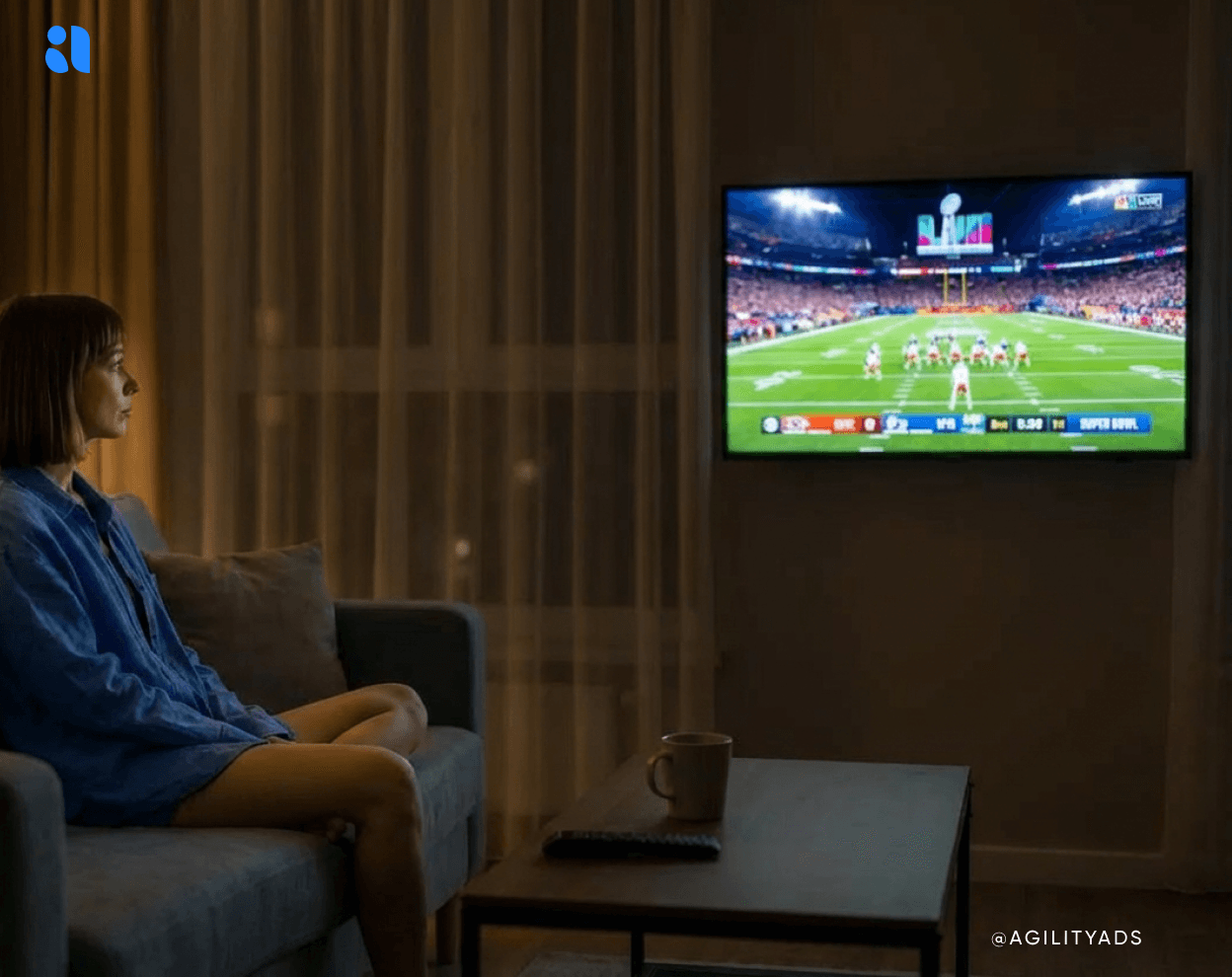
Within 48 hours of each other in early February 2026, two of the world’s largest cultural stages, Super Bowl LX and the Milano Cortina 2026 Winter Olympics opening ceremony, showcased strikingly different visions for how AI fits into mass entertainment. One flooded the airwaves with AI pitches while the other foregrounded human performance while quietly embedding AI into its broadcast infrastructure.
The “AI Bowl”: Super Bowl LX’s Unprecedented AI Advertising Blitz
Super Bowl LX, featuring the Seattle Seahawks and New England Patriots at Levi’s Stadium on February 8, 2026, was the largest-ever showcase for AI-forward advertising on a single broadcast, with AI-focused spots arriving so quickly that many fans were “sick of AI ads” before the first quarter ended. According to TV analytics firm iSpot, 23% of all Super Bowl commercials—15 out of 66 ads—featured AI either in their production or as the core product being sold. Thirty-second in-game placements averaged roughly $8M, with prime positions reaching toward $10M, cementing the game’s status as a showcase for big-budget tech brands. Super Bowl LX “took the field in force” for generative AI and framed this year’s media buy as the spiritual successor to the 2022 “Crypto Bowl,” with AI now occupying the role of tech’s next big swing.
The major players and their approaches
The AI companies buying Super Bowl airtime read like a who’s-who of the sector: OpenAI, Anthropic, Google, Amazon, Meta, Genspark, Base44, Wix, Ramp, Rippling, Ring, and Artlist.io, among others.
Google Gemini – “New Home”
Google’s 60‑second Gemini spot, “New Home” from Google Creative Lab, was one of the most praised ads of the night. The ad followed a mother using Gemini to help her anxious son imagine their new house, repainting his future bedroom blue, placing his toys in a new space, and visualizing a backyard garden, set to Randy Newman’s “Feels Like Home.” The ad positioned Gemini as a “helpful” AI woven into everyday life rather than a sci‑fi technology showcase, aligning with Google’s push to frame Gemini as a “new kind of help” rather than just another chatbot.
OpenAI
OpenAI returned to the Super Bowl with a 60‑second Codex‑focused spot emphasizing human creativity and agency rather than specific feature lists. Variety reported that the ad showcased hands reading, drawing, designing, and coding, while the narrative framed AI as a tool that enhances what individuals can achieve. OpenAI’s CMO Kate Rouch underscored this positioning, saying the company’s marketing goal is to emphasize that “humans are the true heroes” and that AI exists to support their work.
Anthropic
Anthropic used its first in‑game Super Bowl ad to draw a sharp contrast with OpenAI, lampooning the idea of ad-supported chatbots. The spot depicted an AI personal trainer abruptly pivoting into pitching unrelated products, ending with the line: “Ads are coming to AI. But not to Claude.” According to an iSpot survey cited by Adweek, the ad’s likeability ranked in the bottom 3% of Super Bowl commercials over the past five years, with purchase intent significantly below both game‑wide and category norms, and viewers most frequently described their reaction as “WTF.”
Amazon, Meta, Ring, and others
Amazon’s Alexa+ spot featuring Chris Hemsworth leaned into a comedic “AI is out to get me” storyline, using exaggerated mishaps to defuse anxieties about smart assistants overreaching in the home.
Meta emphasized AI‑enabled smart glasses and athletic performance tracking in a co‑branded push with Oakley, positioning AI as an embedded layer in everyday wearables.
One of the night’s most effective AI‑driven concepts came from Ring, which ran a “Be a Hero in Your Neighborhood” campaign around an AI feature that helps find lost dogs by analyzing camera footage. Measurement firm The Measure, using iSpot data, reported that Ring’s spot ranked in the 100th percentile for both attention and likeability, making it the top‑performing AI‑related ad in the game.
AI as production tool: a new frontier
Beyond promoting AI products, several advertisers experimented with AI as a production engine for their creative.
Vodka brand Svedka ran what TechCrunch described as the first “primarily AI‑generated” national Super Bowl spot, “Shake Your Bots Off,” created with production partner Silverside AI. The commercial reintroduced Svedka’s Fembot character alongside a male counterpart, Brobot, rendered through generative tools. Adweek reported that viewers often described the visuals as “weird” or “surreal,” and that iSpot measured brand match at just 7%, far below the 63% norm for alcoholic beverage advertising.
Music licensing platform Artlist.io used its own AI Toolkit to produce an entire 30‑second spot in just five days, parodying familiar Super Bowl tropes such as soda mascots and beer‑brand celebrity cameos to highlight how quickly AI can generate polished creative. A behind‑the‑scenes video shows the team generating storyboards, environments, and character shots using AI tools on an accelerated timeline.
Comcast’s Xfinity leaned on AI for de‑aging, presenting the original Jurassic Park cast as their 1993 selves using AI‑enhanced VFX rather than purely traditional CGI. Across categories, Anomaly chief AI officer Chris Neff suggested that “50% of all Super Bowl spots we watch this year will utilize generative AI in some facet,” whether in ideation, CG work, or personalization.
Audience reception: fascination mixed with fatigue
Despite impressive technical feats, reception was uneven. Adweek’s analysis, using iSpot’s 500‑person survey, found that AI‑category ads prompted confusion rather than clarity, with “WTF” emerging as the most common emotional descriptor. The Measure similarly noted that viewers struggled to parse what differentiated one AI platform from another, even as they remembered the broad theme.
Ben Williams, global chief creative officer at agency DEPT, argued that Svedka’s execution was a “cautionary tale,” telling Adweek that “using AI to make the ad is not the idea” and that when AI as a tool becomes the headline, the resulting work “feels hollow rather than distinctive.” Jeremy Goldman, senior director of content at eMarketer, framed the competitive dynamic bluntly: “AI players are trying to get better awareness for their offerings… Their only chance is brand differentiation.”
In short: utility‑driven concepts like Google’s emotionally grounded “New Home” or Ring’s lost‑dog feature outperformed tech‑for‑tech’s‑sake experiences.
The “Most Intelligent Games in History”: AI at the Milano Cortina Olympics
Just two days earlier, on February 6, 2026, the Winter Olympics officially opened with a multi‑site ceremony based at Milan’s San Siro stadium and extending to venues across Lombardy and the Dolomites.
In an address marking the launch of Alibaba Cloud Intelligenza at the Games, IOC President Kirsty Coventry defined Milano Cortina’s legacy as one of “AI‑powered intelligence” and hailed the debut of the “first‑ever official Large Language Model in Olympic history,” powered by Alibaba’s Qwen models.
A deliberately human ceremony… with one controversial AI sequence
Creative director Marco Balich’s ceremony leaned heavily into physical performance, Italian culture, and analog spectacle. TIME’s review highlighted a “subtly low‑tech aesthetic,” noting that the Olympic rings were massive physical structures lit by fireworks, and that “drone displays and technological one‑upmanship… were not the focus this time.” The magazine concluded: “An obvious choice would have been to trick out the ceremony with flashy, perhaps sponsored deployments of AI. Instead, Milan made the moving choice to honor that essential ingredient of both the arts and athletic achievement: humanity.”
At the same time, a short AI‑generated animated retrospective segment, inserted later in the program, featuring actress Sabrina Impacciatore skiing and skating through a century of Olympic host cities, sparked backlash from some fans and animators. Coverage from Yahoo Entertainment documented social media criticism calling the AI animation “terrible AI garbage” and arguing that a skilled human animator “would have jumped at the chance” to do the sequence. Commentators like Tim Marple pointed to the segment as a “real market lesson” about reputational risk when AI is perceived as replacing human creative labor.
AI powering the broadcast machine
Where AI truly transformed Milano Cortina was behind the scenes. In a joint announcement, Alibaba Cloud, Olympic Broadcasting Services (OBS), and the International Olympic Committee outlined an expanded cloud and AI stack for the Games, including the first LLM‑based systems deployed at the Games.
Key elements included:
Real‑Time 360° Replay: AI algorithms segment athletes from complex snow and ice backgrounds and reconstruct 360‑degree views for replays within roughly 15–20 seconds, enabling broadcasters to show volumetric angles almost live.
Spacetime Slices: A new replay format that compresses multiple phases of a movement, such as a ski jump, into one composite visual to help viewers understand technique.
Olympic AI Assistants: Chat-based assistants on Olympics.com and internal tools, built on Qwen, providing multilingual fan support, real‑time event information, and metadata generation for archival content.
Automated media description: Computer vision and LLMs identify athletes in footage, generate tags, and feed a next‑generation Olympic archive, enabling faster clip discovery for rights‑holding broadcasters.
Cloud-based broadcasting at scale: OBS and Alibaba supported dozens of broadcasters with more than 400 live video feeds, including over two dozen ultra‑high‑definition feeds running through AI‑assisted workflows for encoding, routing, and monitoring.
Two stages, two philosophies, one clear lesson
Taken together, Super Bowl LX and the Milano Cortina opening ceremony show two sharply different philosophies for showcasing AI at scale. The Super Bowl turned commercial breaks into an AI arms race. At least 15 of 66 ads (23%) featured AI, with AI brands reportedly spending around $120M on media alone. Milano Cortina, by contrast, kept AI mostly invisible within infrastructure and broadcast tools, while the on‑stage spectacle largely celebrated human artistry, aside from a single AI animation segment that drew criticism.
Jeremy Goldman of eMarketer summarized the competitive reality for AI brands: “At this year’s Super Bowl, the real showdown played out in the ad breaks, where AI companies jockeyed for attention,” and their “only chance is brand differentiation.”
The brands and organizers that came out ahead, such as Google with an emotionally grounded Gemini story, Ring with a concrete neighborhood utility, and the IOC with AI‑enhanced but human‑centered ceremonies, treated AI as an enabler rather than the show itself.
Turning AI from spectacle into strategy
The core takeaway for marketers and entertainment leaders: AI works best when it serves a strong human story. Super Bowl LX showed that simply shouting “AI” and relying on novelty can generate awareness, but not necessarily comprehension or trust. Milano Cortina showed that AI can dramatically upgrade operations, replays, archives, and fan experiences without dominating what audiences see on stage or on the field of play.
For brands, the opportunity is to harness AI in three complementary ways:
Strategic insight: Using AI to model audiences, inform creative territories, and test messaging before major launches.
Creative production: Using generative tools to accelerate concepting, previsualization, and VFX, while still anchoring ideas in human strategy and craft.
Experience and delivery: Applying AI in personalization, media optimization, and measurement to ensure each impression lands with the right person in the right context.
How Agility helps brands do this well
That’s exactly where Agility focuses. As a precision brand advertising platform, Agility helps marketers leverage AI‑enhanced creative and data‑driven delivery across CTV, programmatic display, and premium digital environments without losing the human insight and brand discipline that separates memorable work from forgettable experiments.
Agility’s platform combines advanced persona insights, behavioral and contextual data layering, and custom optimization algorithms to ensure that every impression serves a clear strategic purpose. Whether the goal is to use AI to streamline creative variations, build more relevant CTV storytelling, or refine reach and frequency across channels, Agility’s precision approach turns AI and machine learning from a stunt into a performance driver. Working with a partner built around long-term brand advertising outcomes becomes a key competitive advantage.
Get started with precision brand advertising today.
Share in...